 CharlemagneBlessed · 748–814Charlemagne was King of the Franks from 768, King of the Lombards from 774, and Emperor of the Carolingian Empire from 800. He united most of Western and Central Europe and was the first recognised emperor to rule from the west after the fall of the Western Roman Empire about three centuries earlier. His reign brought political, social and cultural changes that shaped Europe throughout the Middle Ages, and many historians call him the Father of Europe.
 Joan of ArcVenerable · 1412–1431Joan of Arc is a patron saint of France, honored as a defender of the French nation for her role in the siege of Orléans and in securing the coronation of Charles VII during the Hundred Years' War. Claiming to act under divine guidance, she became a military leader who gained recognition as a savior of France. Born to a peasant family in northeast France, she was tried for heresy by an English-backed court and burned at the stake in 1431, aged about nineteen. Her legend grew steadily afterward.
 Thomas AquinasSaint · 1225–1274Thomas Aquinas was an influential Italian Dominican friar, priest, and philosopher who lived from approximately 1225 to 1274. A central figure in medieval scholasticism, he developed a philosophical system known as Thomism by synthesizing Aristotelian thought with Christian doctrine. His extensive writings, including the unfinished Summa Theologica, addressed complex questions of theology, ethics, and natural reason. Recognized as one of the most significant thinkers in Western history, he is honored as a saint and a Doctor of the Church, holding titles such as the Angelic Doctor.
 Francis of AssisiSaint · 1182–1226Francis of Assisi (born Giovanni di Pietro di Bernardone, c. 1181 – 1226) was an Italian mystic, poet and Catholic friar who founded the religious order of the Franciscans. Born into a wealthy merchant family in Assisi, he turned toward a life of poverty and devotion as a young man, repairing chapels and caring for the sick. He later gathered followers, and after receiving papal approval the Order of Friars Minor grew rapidly under his leadership. He was canonized in 1228 and is one of the most venerated figures in Christianity.
 William of Ockham1287–1349William of Ockham was a prominent 14th-century English Franciscan friar, philosopher, and theologian. Born around 1287, he studied at the University of Oxford before becoming embroiled in intense intellectual and political conflicts. He is famously associated with the principle of parsimony, known as Ockham's razor, which suggests that simpler explanations are preferable. His work significantly influenced medieval thought, particularly through his development of nominalism, a philosophical position regarding universals. After fleeing the papal court in Avignon due to disputes over apostolic poverty, he spent his final years in Munich under imperial protection.
 Anselm of CanterburySaint · 1033–1109Anselm of Canterbury was an 11th-century Benedictine monk, theologian, and philosopher who served as the Archbishop of Canterbury from 1093 to 1109. Born in Aosta, he later became the abbot of Bec in Normandy, where he established the monastery as a major center of European learning. He is widely recognized as a pioneer of Scholasticism and is famous for developing the ontological argument for God's existence. Throughout his ecclesiastical career, he defended church interests against English monarchs, which led to multiple periods of exile.
 Albertus MagnusSaint · 1193–1280Albertus Magnus was a 13th-century German Dominican friar, philosopher, and scientist. Born in Lauingen around 1193, he became a prominent scholar and served as the Bishop of Regensburg. He is celebrated for his vast intellectual contributions, having extensively commented on the works of Aristotle and integrated Aristotelian thought into medieval academic study. As a teacher, he famously instructed Thomas Aquinas, helping to shape the scholastic tradition. Recognized for his encyclopedic knowledge across many disciplines, he is honored as a saint and a Doctor of the Church.
 Hildegard of BingenSaint · 1098–1179Hildegard of Bingen was a 12th-century German Benedictine abbess and polymath known for her diverse intellectual and spiritual contributions. Born around 1098, she was a visionary who experienced mystical experiences from a young age. As a leader, she established the monasteries at Rupertsberg and Eibingen. Her vast body of work includes theological writings, musical compositions, and scientific observations in natural history and medicine. Recognized as a Doctor of the Church, she remains one of the most influential women of the High Middle Ages.
 Celestine VSaint · 1215–1296Celestine V, born Pietro Angelerio, was an Italian Benedictine monk and hermit who served as pope for five months in 1294. After a two-year deadlock among cardinals, the ascetic known as Peter of Morrone was elected to lead the Catholic Church. Following his brief reign, he became the first pope to abdicate his office, seeking to return to his former life of solitude. His resignation established a precedent for the right of a pope to step down from the papacy.
 Urban IIBlessed · 1035–1099Urban II was a Benedictine monk who served as the head of the Catholic Church from 1088 until his death in 1099. Born Odo of Châtillon, he previously held positions as the prior of Cluny and the cardinal-bishop of Ostia. He is most famous for his speech at the Council of Clermont, which launched the First Crusade by calling for military expeditions to reclaim the Holy Land. During his papacy, he navigated intense political conflicts involving the Holy Roman Empire and worked to implement various Gregorian reforms within the church hierarchy.
 Alfred the GreatSaint · 849–899Alfred the Great was a 9th-century monarch who ruled the West Saxons starting in 871 and the Anglo-Saxons from 886. Born around 849 in Wantage, he was the son of King Æthelwulf. He is widely recognized for his military leadership, particularly his victory against Viking forces at Edington in 878, which led to a division of territory with the Danelaw. Beyond his role as a warrior and politician, he was an influential writer and reformer who significantly improved the legal and military systems of his kingdom.
 Urban VBlessed · 1310–1370Urban V was a Benedictine monk who served as pope from 1362 until his death in 1370. Born Guillaume de Grimoard around 1310, he was a distinguished scholar of canon law who taught at several universities, including Montpellier and Paris. Before his election to the papacy, he held various ecclesiastical roles, including serving as the abbot of Monte Cassino. Known for his commitment to the Benedictine Rule, he maintained a modest lifestyle that often contrasted with the habits of his contemporaries in the church hierarchy.
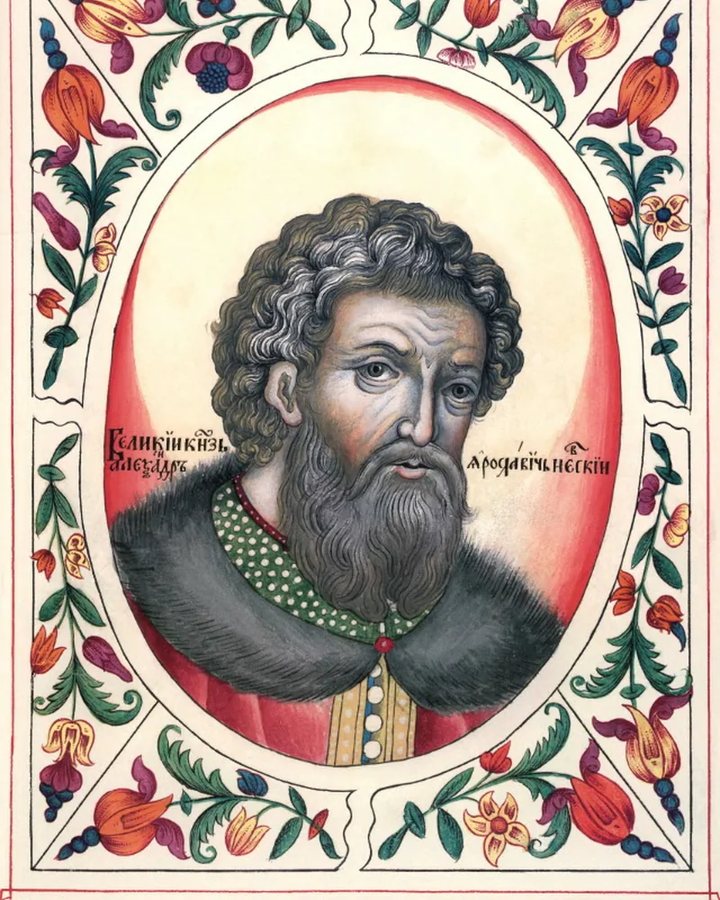 Alexander NevskyRight-believing · 1220–1263Alexander Nevsky was a 13th-century ruler of several Russian principalities, including Novgorod and Vladimir. Born in Pereslavl-Zalessky around 1221, he became a prominent military leader known for defending his territories against foreign incursions. He is most famous for his victories over Swedish forces at the Neva River and against German crusaders during the Battle on the Ice. By choosing to pay tribute to the Golden Horde, he sought to protect the Eastern Orthodox Church from Western influence. He died in Gorodets in 1263 and is venerated as a saint in both Catholic and Orthodox traditions.
 Dmitry DonskoySaint · 1350–1389Dmitry Donskoy was a 14th-century Grand Prince of Moscow and Vladimir who reigned from 1359 until his death in 1389. Born in Moscow, he ascended to power as a child following his father's death and was initially guided by Metropolitan Alexius. He is most famous for being the first Russian ruler to directly confront Mongol authority, achieving a significant military triumph against the forces of Mamai at the Battle of Kulikovo in 1380. This victory, which earned him his nickname, helped consolidate the prestige and authority of the Moscow principality.
 Thomas BecketSaint · 1119–1170Thomas Becket was a 12th-century English statesman and cleric who served as Lord Chancellor before becoming the Archbishop of Canterbury. Born in London, he rose through the ecclesiastical ranks under Archbishop Theobald of Bec, eventually gaining the favor of King Henry II. However, his appointment as archbishop led to a significant confrontation with the monarch regarding the legal privileges of the Church. This struggle resulted in a period of exile and ultimately led to his violent death within Canterbury Cathedral.
 BonaventureSaint · 1221–1274Bonaventure was an influential Italian Franciscan theologian, philosopher, and bishop who lived from 1221 to 1274. Born in Bagnoregio, he rose through the Franciscan Order to become its Minister General and later served as the Cardinal-Bishop of Albano. A prominent academic, he studied and taught at the University of Paris, where he was a contemporary of Thomas Aquinas. He is celebrated for his efforts to harmonize rational inquiry with religious faith, a pursuit that defined his extensive theological contributions during the Middle Ages.
 Edward the ConfessorSaint · †1066Edward the Confessor was an Anglo-Saxon monarch who ruled England from 1042 until his death in 1066. As the final ruler of the House of Wessex, he ascended the throne following the death of Harthacnut. Born in Islip to Æthelred the Unready and Emma of Normandy, Edward spent much of his youth in exile, likely in Normandy, due to Danish rule in England. His reign, lasting twenty-four years, ended just before the Norman Conquest, which saw his successor, Harold Godwinson, defeated at the Battle of Hastings.
 Gregory VIISaint · 1020–1085Gregory VII, born Hildebrand of Sovana around 1020, was a Benedictine monk who served as the Pope of the Catholic Church from 1073 to 1085. Before his election by acclamation, he worked as a papal administrator and the Abbot of Saint Paul Outside the Walls. He is most famous for initiating the Gregorian Reform, a movement aimed at increasing papal authority and cleaning up ecclesiastical corruption. His leadership was marked by intense political conflicts, particularly his repeated excommunications of Holy Roman Emperor Henry IV.
 Stephen I of HungarySaint · 969–1038Stephen I of Hungary was the first king of Hungary, ruling from approximately 1000 until his death in 1038. Born Vajk to Grand Prince Géza and Sarolt, he transformed the Hungarian state by unifying the Carpathian Basin and establishing a Christian kingdom. After succeeding his father, he consolidated power by defeating rival chieftains and securing his authority through a marriage to Gisela of Bavaria. As an apostolic king, he laid the foundations for the nation's religious and administrative structures, ensuring the country's independence and its integration into Christian Europe.
 Bernard of ClairvauxSaint · 1090–1153Bernard of Clairvaux was a 12th-century Cistercian abbot, mystic, and influential theologian from Burgundy. After joining the Cistercian Order, he founded Clairvaux Abbey and became a central figure in the reform of the Benedictine tradition. Known for his powerful rhetoric and deep spirituality, he served as a diplomat and preacher, notably supporting Pope Innocent II during a period of papal schism and advocating for the Crusades. His theological focus on personal devotion and his significant role in spreading Marian devotion have left a lasting impact on Christian thought.
 John Duns ScotusBlessed · 1265–1308John Duns Scotus was a prominent Scottish Franciscan friar, theologian, and philosopher who lived from approximately 1265 to 1308. A highly influential figure in late medieval Western Christendom, he taught at prestigious institutions such as the University of Oxford and the University of Paris. Known for his penetrating intellect, he earned the nickname Doctor Subtilis (the subtle Doctor). His extensive academic contributions, particularly his commentaries on the works of Peter Lombard, established a distinct intellectual tradition known as Scotism.
 Olga of KievEqual-to-the-apostles · 890–969Olga of Kiev was a 10th-century regent of Kievan Rus' who governed on behalf of her son, Sviatoslav, from 945 to 957. Following the death of her husband, Prince Igor, she famously exacted violent retribution against the Drevlian tribe for his murder. As the first Rurikid ruler to be baptized, she paved the way for her grandson, Vladimir the Great, to establish Christianity as the state religion. She is honored in the Eastern Orthodox tradition as a saint with the title "Equal to the Apostles."
 Louis IX of FranceSaint · 1214–1270Louis IX of France was a medieval monarch who ruled his kingdom from 1226 until his death in 1270. Born in Poissy, he ascended to the throne at age twelve under the regency of his mother, Blanche of Castile. He is recognized as the only French king to be canonized as a saint. His reign is noted for significant legal reforms and territorial expansion, though it ended during the Eighth Crusade in Tunis, where he died from dysentery.
 Jan Hus1372–1415Jan Hus was a Czech theologian, philosopher, and preacher who became a central figure in the Bohemian Reformation. Born in Husinec around 1372, he served as a professor and rector at the University of Prague before becoming a prominent preacher at the Bethlehem Chapel. He is recognized as a precursor to Protestantism, as his critiques of clerical corruption and certain Church doctrines influenced later reformers like Martin Luther. His refusal to recant his theological views led to his execution by burning at the stake in Constance in 1415.
 Paschal ISaint · 775–824Paschal I was a Roman pope and leader of the Papal States who reigned from 817 until his death in 824. Born into an aristocratic family in Rome, he previously served as an abbot managing a monastery for pilgrims. His papacy was marked by significant architectural projects and complex political interactions with the Carolingian Empire, including the coronation of Lothair I as Holy Roman Emperor. He is remembered for his support of iconophile monks fleeing Byzantine persecution and his extensive rebuilding of several Roman basilicas.
 Leo IIISaint · 750–816Leo III was the pope of the Catholic Church and leader of the Papal States from 795 until his death in 816. Born in Rome around 750, he served as a cardinal-priest under Adrian I before his own election. His pontificate was marked by a close alliance with the Frankish ruler Charlemagne, whom he famously crowned emperor in 800. Despite facing violent physical attacks and legal accusations from political rivals, Leo maintained his position through the protection of the Carolingian dynasty.
 Vladimir the GreatEqual-to-the-apostles · 956–1015Vladimir the Great (c. 958 – 1015) was Prince of Novgorod from 970 and Grand Prince of Kiev from 978 until his death. Born the illegitimate son of Sviatoslav I, he seized power after a fratricidal struggle, expanded his realm to the Baltic Sea and defended its frontiers. Originally a pagan, he adopted Christianity in 988 and brought it to Kievan Rus'. The Catholic Church and the Eastern Orthodox Church both canonised him as Saint Vladimir.
 Gregory XBlessed · 1210–1276Gregory X, born Teobaldo Visconti around 1210 in Piacenza, was a Cistercian who served as the head of the Catholic Church from 1271 until his death in 1276. His election followed the longest papal vacancy in the history of the Church, which had lasted from 1268 to 1271. During his papacy, he oversaw the Second Council of Lyon and established significant new rules for the conduct of future papal elections. He is recognized as a blessed in the Catholic tradition.
 John Wycliffe1320–1384John Wycliffe was a 14th-century English theologian, philosopher, and scholar who taught at the University of Oxford. Born in Hipswell around 1320, he became a prominent dissident within the Catholic Church, advocating for radical clerical poverty and the divestment of church property. His political-theological theories questioned the temporal authority of the clergy and the legitimacy of church wealth. Often regarded as a precursor to the Protestant Reformation, his writings and ideas significantly influenced later reformers, including Jan Hus.
 Konstantinos XI PalaiologosSaint · 1404–1453Konstantinos XI Palaiologos was the final reigning emperor of the Byzantine Empire, holding the throne from 1449 until 1453. Born in Constantinople to Emperor Manuel II and the Serbian noble Helena Dragaš, he was a skilled military leader who previously served as the Despot of the Morea. His reign was defined by efforts to secure Western military aid through church union and the desperate defense of his capital against the Ottoman Empire. He died in battle during the fall of Constantinople, marking the end of the Eastern Roman Empire.
